Women in AI Kaunas: how AI is changing daily work
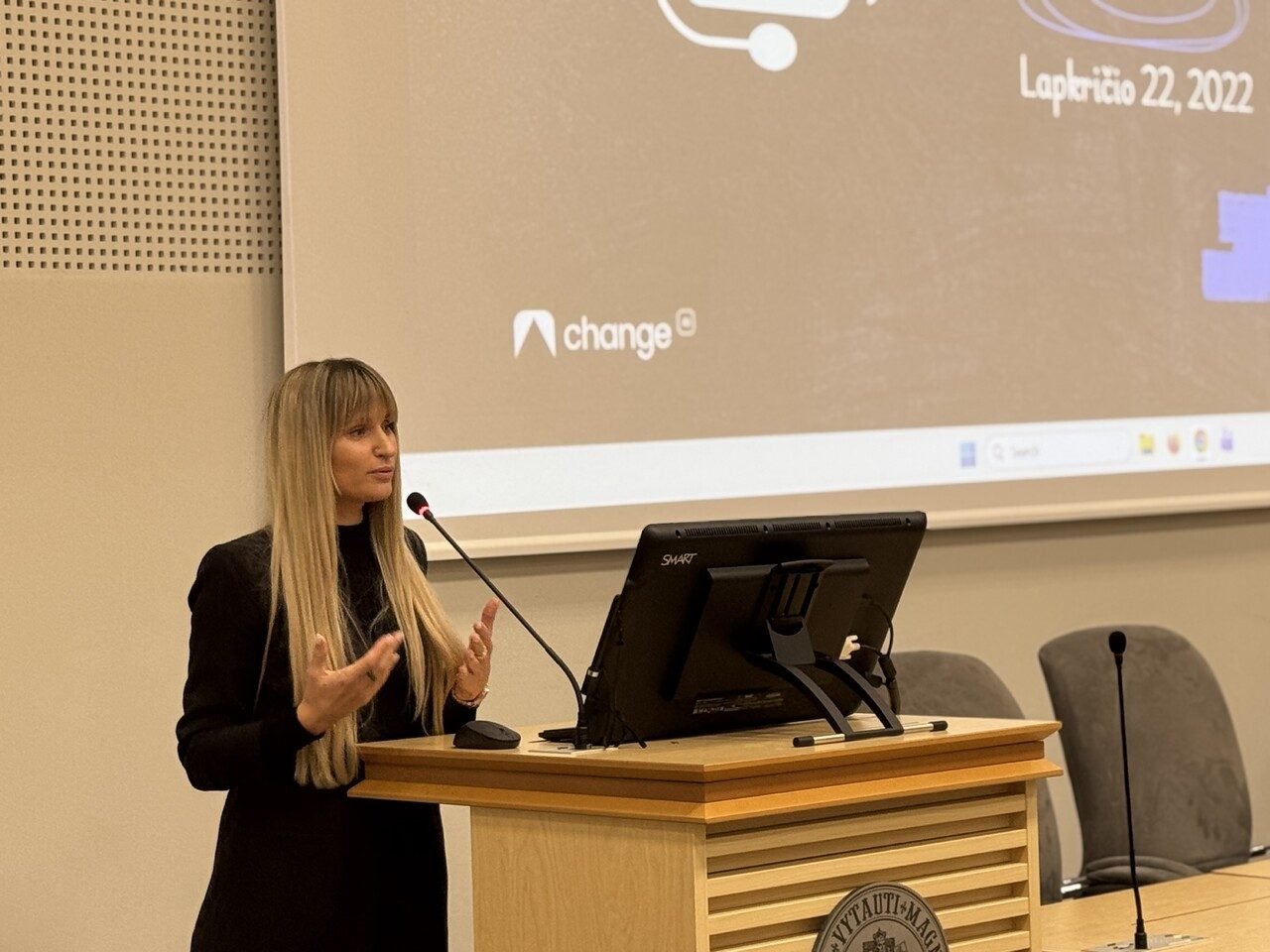
On 11 November 2025, Odeta Isevičiūtė spoke at Mokslas + Verslas = DI Pažanga? ("Science + Business = AI Progress?"), the first Kaunas event of the Women in AI Lithuania chapter. Her talk was about the changing role of AI in daily work.
The event
Women in AI organised the evening at Vytautas Magnus University (VDU), in the university's Senate hall at S. Daukanto g. 28, Kaunas. It ran from 18:00 to 20:30 and was free to attend [1]. As the title suggests, the evening paired a business view of AI with an academic one.
What we did there
Odeta gave an evening talk in Lithuanian. She opened with the myths people repeat about AI: "AI agents don't work", "jobs are about to disappear", "ChatGPT makes things up", "you can't trust AI at all", "AI has already changed the world". Then she put a date on the screen: 22 November 2022, the day ChatGPT launched. Generative AI was less than three years old.
The first half took the long view: how production and digital work have changed over two centuries, why it is so hard to judge where AI is heading, and how to work while the answer is still unknown. She closed with the practical side, the levels of AI use in a company.
Three takeaways from the talk
1. Big technologies take decades, and AI is still at the app stage
Odeta's point was that innovation needs time to show its impact. From discovery to full effect often takes ±30–70 years. The light bulb, the internal combustion engine and the first car, ARPANET and, decades later, Facebook all followed that curve. And innovations make further innovations possible: the biggest change usually comes from what gets built on top of the original technology.
She sees generative AI as infrastructure, like the smartphone. First come apps and features. New business and behaviour models arrive later. So the version of AI people use at work today is an early one, and daily work will keep changing as the next layers get built.
2. Learn AI tools whatever your role
Odeta told a story about two people. In 2023 ChangeAI hired a sales manager from India who had almost no AI experience. About a month later he was building small AI side businesses over the weekend, using AI to do it. Around the same time she met a social media freelancer who complained that AI was taking her work, yet refused to use it because she felt she wrote better.
Her tip: learn to use AI tools in your work, whatever your role, seniority, experience or degree. If in 2025 you are not actively learning AI tools, she said, you'll soon be replaced by people who are. In her words, "the 2020s are the 2000s on steroids". In 2000 the internet revolution happened mostly in Silicon Valley, out of reach for most people in Lithuania. This time everyone can take part.
3. Think of AI like a new internet
Her last tip was to treat AI the way companies once had to treat the internet, and to ask the same kinds of questions:
- Which problems can we solve now?
- Which new business models open up?
- How can we improve our processes?
- Is a bigger business change possible?
- How will I and the people around me change?
- What was impossible before and is possible now?
The answers will look different for every team, and they will change as the technology does.
If you want your team to build that learning habit, have a look at the AI Skills Development programme.
Sources and notes
- Mokslas + Verslas = DI Pažanga?, Women in AI, Eventbrite.