Vilnius AI Summit 2025: open-source AI beyond ChatGPT
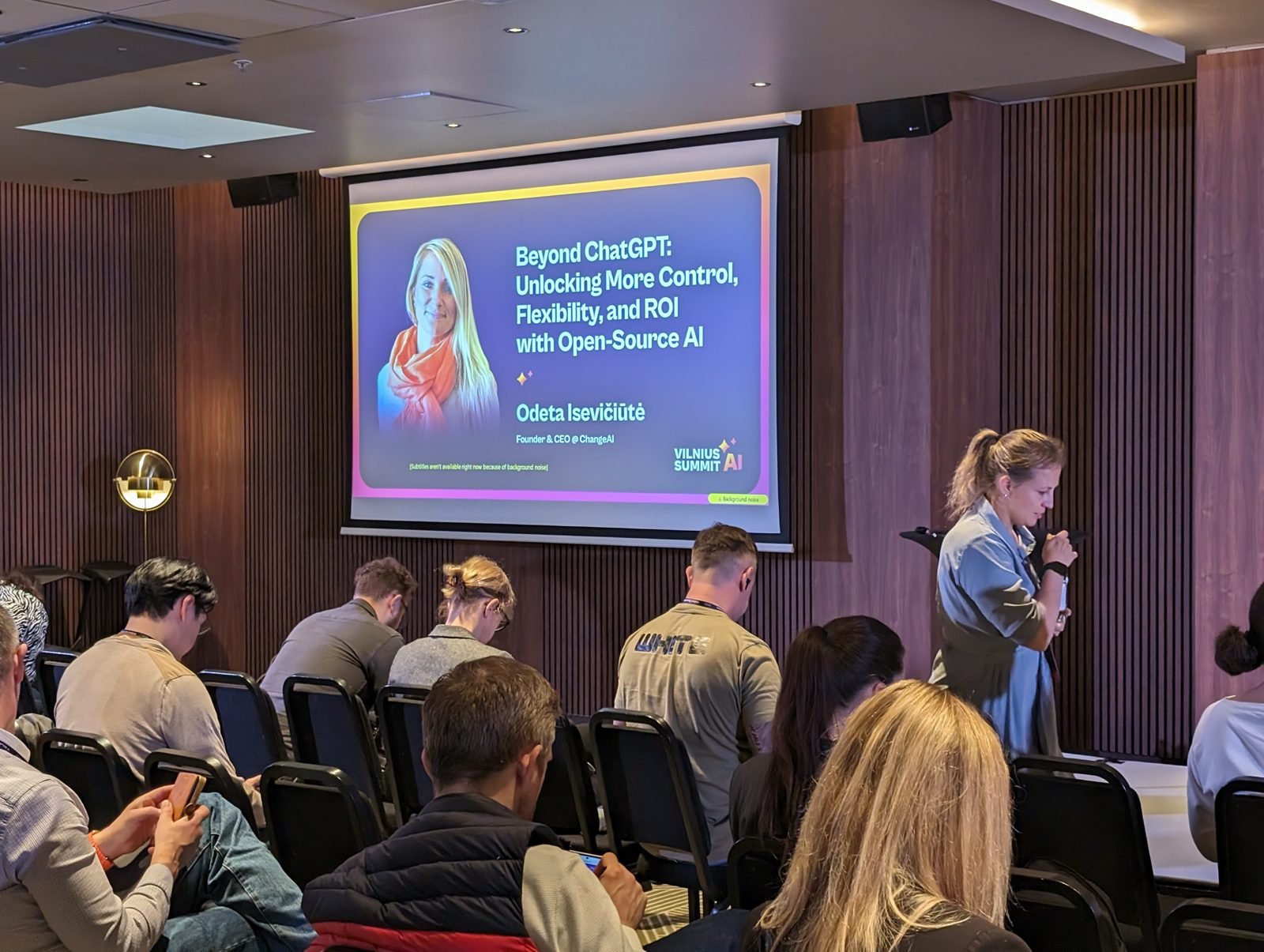
On 15 April 2025, Odeta Isevičiūtė spoke at Vilnius AI Summit 2025, organised by AI.LT in Vilnius. Her talk: "Beyond ChatGPT: Unlocking More Control, Flexibility, and ROI with Open-Source AI".
The event
Vilnius AI Summit is AI.LT's conference for business decision-makers. The 2025 edition took place on 15–16 April at the Radisson Blu Hotel Lietuva in Vilnius, with more than 60 talks and workshops across five stages.
What we did there
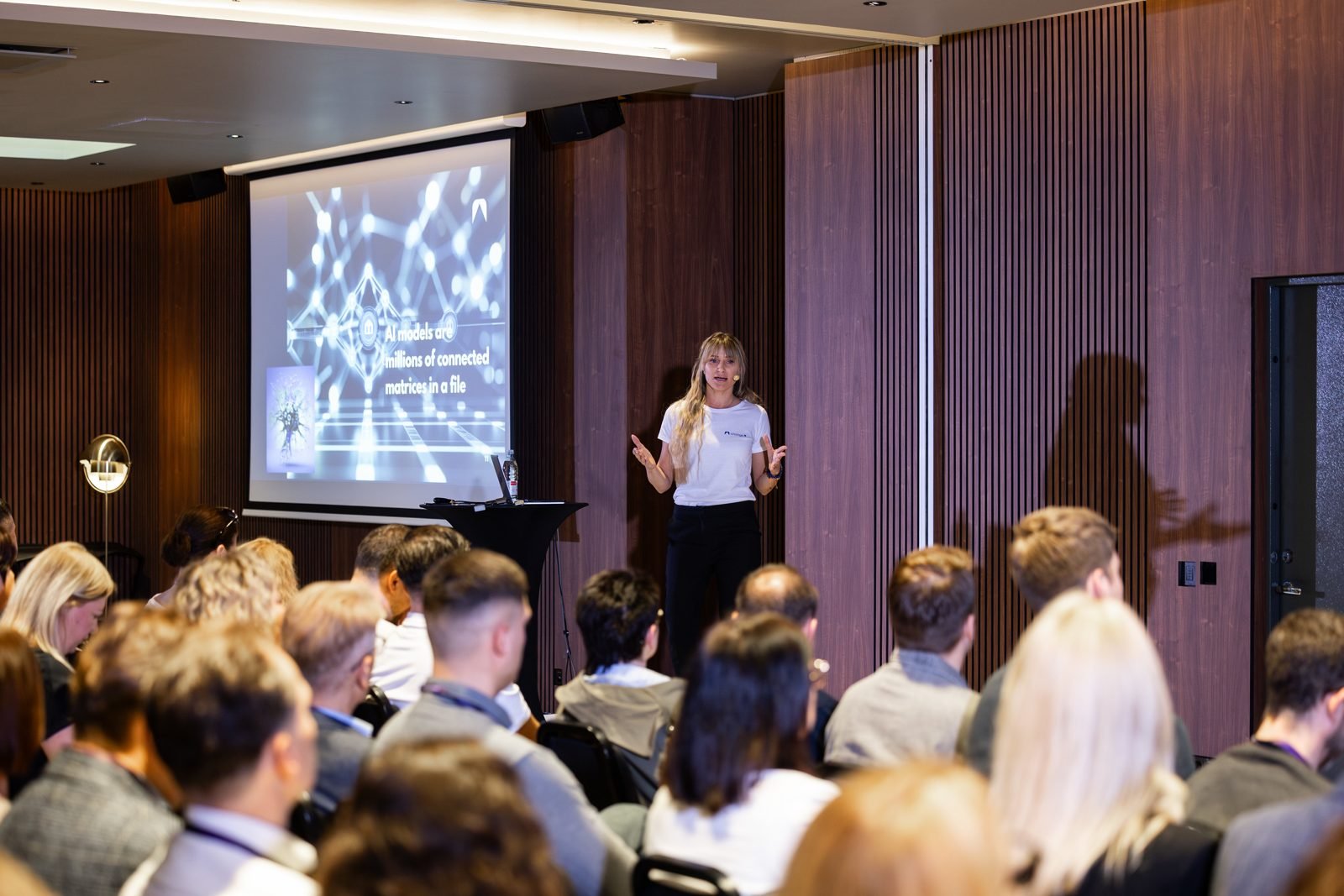
Odeta gave a talk on the first day of the summit, aimed at leaders weighing what to build on after their first months with ChatGPT or Gemini. She compared closed and open AI models side by side, walked through the main open models, and covered how a company can run an open model on its own terms.
A note on timing: this is the April 2025 view. Open models have moved fast since then, so treat the model details below as a snapshot of that spring.
Three takeaways from the talk
1. Open models give you customisation and flexibility
Ready-made tools like ChatGPT and Gemini are convenient, and Odeta named their limits plainly: vendor lock-in, sensitive data processed outside the company, usage-based costs that grow unpredictably as adoption spreads, and little room to change how the model behaves beyond the prompt.
Open models such as Mistral, Llama and DeepSeek give a business the code, the weights and the freedom to fine-tune behaviour, tone and accuracy for its own use cases. The main gap she flagged for Lithuanian companies at the time was language: Llama already supported Estonian and Latvian, and Lithuanian was still missing.
2. Data control and privacy come from the hosting choice
Owning the model only protects your data if you also choose where it runs. Odeta laid out three hosting options:
- Cloud hosting (for example AWS, Azure or Hugging Face): fast to set up and managed for you, with serverless and auto-scaling setups that cut costs for uneven workloads. The trade-off is cost at volume and dependence on the provider.
- On-premise hosting: maximum control and full data privacy, with new hardware built for AI making it cheaper to run models in-house. The trade-off is upfront cost and maintenance.
- Distributed GPU networks (for example NeurochainAI or Together AI): shared computing power from many providers, with clearer cost visibility. Still an early approach that needs some understanding of decentralised infrastructure.
The talk covered how to put an open model such as Mistral-7B onto this kind of infrastructure and how to compare performance, cost and flexibility.
3. Weigh cost against your own usage and strategy
Her comparison table made the trade-off clear. Closed models are cheap to start, need no infrastructure and are often top of the benchmarks, with pay-per-use pricing and your roadmap tied to theirs. Open models cost more upfront in infrastructure, skills and setup time, then give you freedom to switch models or hosts. Her advice for decision-makers: evaluate cloud, on-premise and decentralised hosting against your actual AI usage, budget and long-term plans.
If your team needs to decide which AI tools to build on, the AI Opportunities programme maps that out with you.
Sources and notes
- AI.LT, organiser of Vilnius AI Summit.
- AI.LT company profile, village.ai.
- Model support and hosting options reflect the state of open-source AI in April 2025.