DI pramonėje (LINPRA): a hoe or a tractor for office work
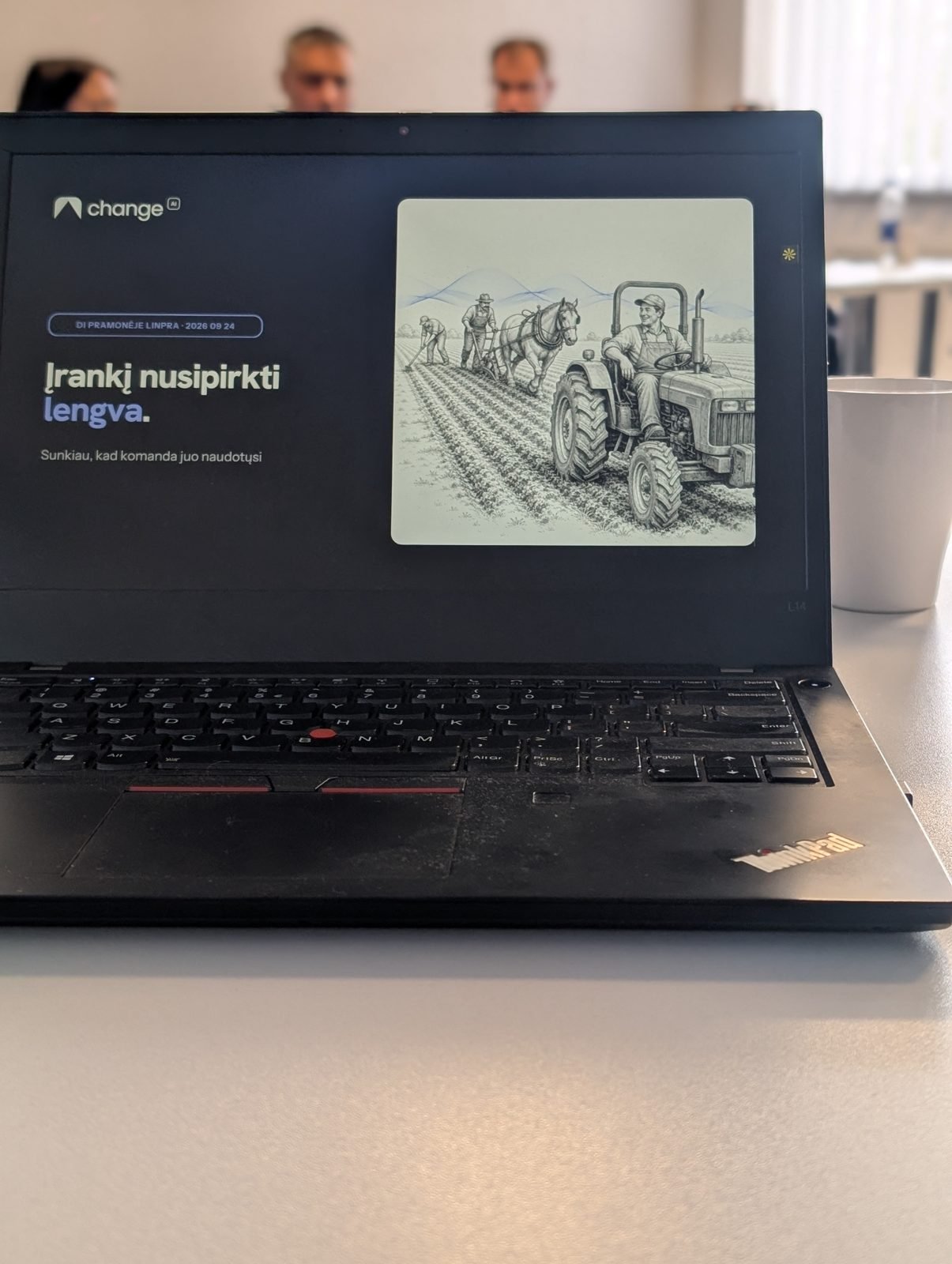
On 24 September 2026, Odeta Isevičiūtė spoke at DI pramonėje ("AI in industry"), an event for member companies of LINPRA, the Engineering and Technology Industries Association of Lithuania. Her title slide read "Įrankį nusipirkti lengva. Sunkiau, kad komanda juo naudotųsi" (Buying a tool is easy. Getting the team to use it is harder.), next to a drawing of one field worked by hoe, by horse-drawn plough and by tractor. From there she covered how AI has already changed work at the computer, and what manufacturers and engineering firms can hand over to it first.
The event
LINPRA brings together Lithuania's manufacturing and engineering companies. DI pramonėje was for its member companies. The audience sat at tables in a meeting room, and before the event they filled in a survey about how they use AI today. Two themes from that survey shaped the talk: how other companies are using AI, and how to keep company data safe.
What we did there
Odeta gave a talk in Lithuanian, about 18 slides long, built on the AI Iceberg and on examples from ChangeAI training sessions, including one at a company in the association. She answered the data security question from the survey directly, then walked through the jobs AI already does well. The talk closed with a question for the room: "Kur jūsų įmonė yra AI ledkalnio lygiuose?" (Where is your company on the levels of the AI Iceberg?)
Three takeaways from the talk
1. The biggest obstacle is not knowing what the tools can do
Office work has changed the way machines changed farming, and each company and person still chooses the tool they pick up in the morning: "kaplys ar traktorius", a hoe or a tractor. Odeta named three barriers. People hear plenty of stories about what AI can do but have no idea how to get there. Our brains are built for stability, so "renkamės pažįstamą diskomfortą" (we choose the discomfort we know). And many firms still won't pay for licences, while free versions offer very limited features. The first barrier is the largest. Most people use chat at the tip of the iceberg, while ChatGPT, Claude, Copilot and Gemini already let you build assistants and schedule work to run on its own, with no IT project.
2. The first jobs to go: copying data, building reports, analysing data
Copying data between systems by hand is first. In a training session at one of the association's companies, orders arrived by email and were typed into the ERP. With no ERP connector yet, AI can still collect the orders from email and produce a CSV file the ERP accepts, and one person uploads it at agreed times. Building reports, filling in contracts and creating documents from existing information come next, because agents in Cowork and Work can open and edit files on your computer or in the cloud. Data analysis is the third: the platforms pair a large language model as the brain with Python as the hands. Odeta's point was that AI handles these structured jobs even better than marketing copy, where there is always room for interpretation.
3. Paid business accounts protect your data, and the change still needs managing
Business accounts from all the major platforms contractually exclude your data from model training and from human review. Copilot gives data put into AI the same protection as the rest of Microsoft 365. Companies that want to protect their data should pay for AI tools. If a company does not pay but already has Microsoft 365, the Copilot that comes with it is the safest way to use AI.
Once people who want to drop manual work have the right tool, time and room to experiment, change starts on its own in small processes, much like Kaizen. It still has to be managed: deciding how individual automations join into processes, how often the team reviews them, and which steps before and after an automation can be connected to it.
If you want to see where your team sits on the iceberg before choosing the first process, AI Opportunities starts with that map.