First Logistics: from 2 to 7 AI ambassadors
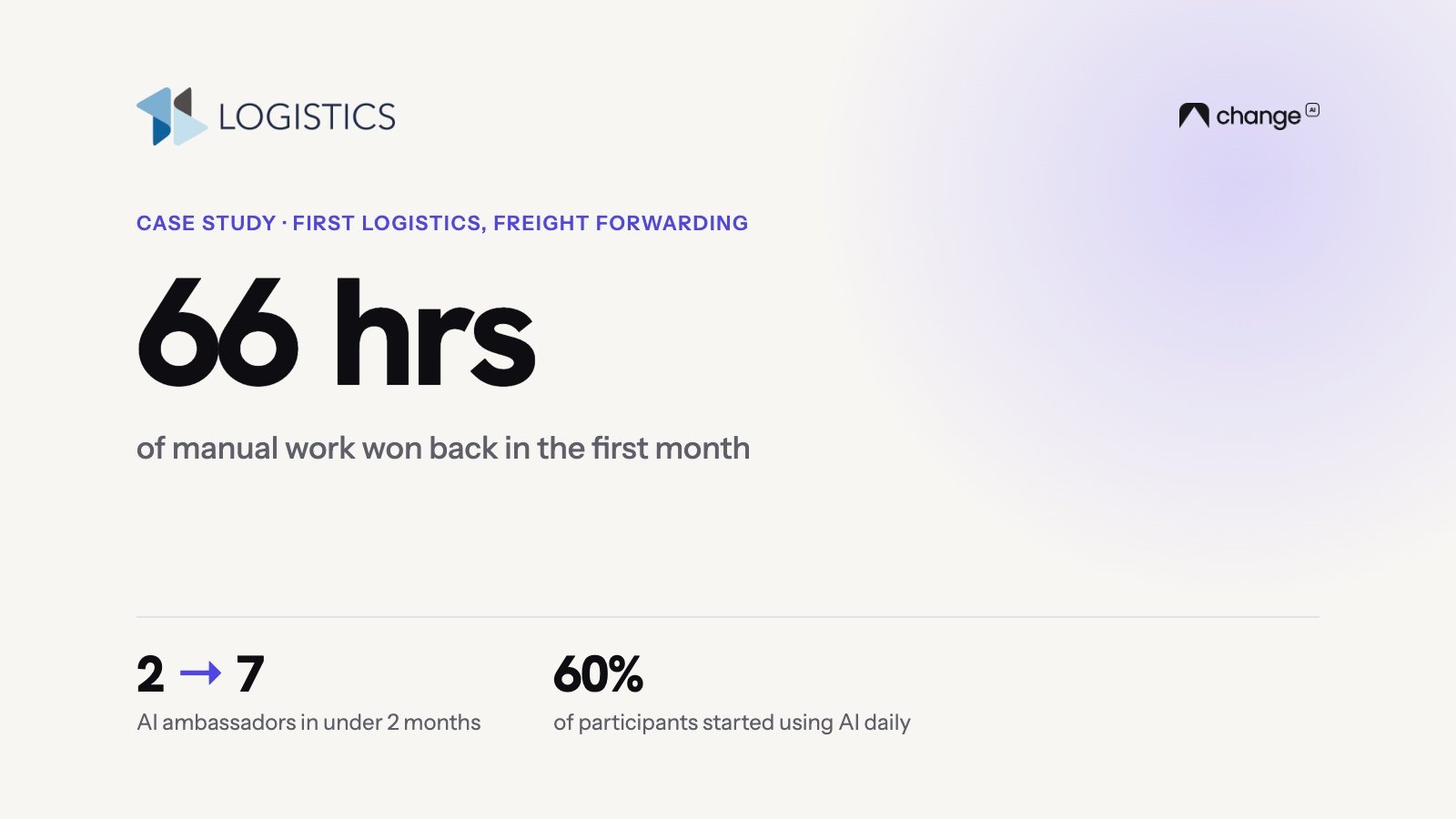
In its first month, the First Logistics team won back 66 hours of manual work. That figure comes from eight processes the staff documented during the training alone. In under two months, the number of AI ambassadors in the company went from two to seven.
| 66 hours | 2 → 7 | 70% |
|---|---|---|
| of manual work in the first month, 8 documented processes | AI ambassadors in under 2 months | ChangeAI's contribution, as estimated by Head of IT and Finance Marius |
Before the program
First Logistics is an international freight forwarding company. Its team works every day with bills of lading, customs documents, shipping line rates and customer communication. Marius, Head of IT and Finance, came to ChangeAI with a specific aim: find out whether an AI training program was worth a company-wide investment.
Before the training, 34 employees filled in a questionnaire. 53% of them used AI rarely or not at all. Most gave the same reason: they didn't know how to apply AI to their daily work. People were ready; nobody had shown them a concrete place to start.
During the program
The program had four sessions: two with the whole team (with homework in between) and two strategy sessions with management.
The team builds its first AI assistants. Staff got structured tasks: build Google Gems for their daily work, try NotebookLM on real work documents, and note the processes where time gets lost. During the program 80% of participants tried AI tools and 60% started using them daily. For many, it was the first time they saw with their own eyes what AI could do with their specific task.
A rates database in a few hours. In the strategy sessions, we worked out with management that the biggest drain on time was collecting shipping rates and sending them to customers. Partners email their prices in different formats, and someone has to gather, compare, select and send them on. It happens dozens of times a day.
In the session we showed how to connect Claude to a mailbox and build a working solution from unstructured data. Marius did exactly that afterwards: he connected Claude to the company mailbox where all partner rates arrive, and in three prompts built a database that pulls the prices together and lets the team send offers to customers directly. A few hours, one person's work.
"Before the training I knew where the problem was. After the training I knew how to solve it. And I built it myself in a couple of hours." Marius, Head of IT and Finance, First Logistics
AI Fridays and bonuses for results. In the strategy sessions we kept making one point: the people who work with a process every day are the best placed to improve it with AI. Outside specialists won't do it better. We also suggested a concrete idea: get people sharing what they've learned and motivating each other. CEO Aleksandras turned that into company policy: on Friday afternoons the whole company meets during working hours to learn to apply AI, and the solutions with the biggest impact earn bonuses.
Process tracking: real numbers. Staff recorded 14 recurring tasks that take the most time. For eight of them we had precise enough data on the time saved:
| Process | Before | With AI |
|---|---|---|
| Standard emails for bills of lading (80 a month) | 10 min | 2 min |
| Checking draft bills of lading | 15 min | 4 min |
| Looking up shipping line rates and free days (40 a month) | 20 min | 2 min |
| Handling bank invoice queries | 30 min | 2 min |
In total, 66 hours in the first month, during the program alone. Best of all, the staff found the solutions for their own daily work themselves.
After the program: what the team does on its own
In the under two months since the program, AI uses and AI enthusiasts at First Logistics have kept multiplying.
Friday sessions became a habit. Every other Friday the team meets and presents what it has built with AI. People learn from each other and show their own solutions. More and more staff want to join.
From two AI ambassadors to seven. At the start of the program, AI was used and applied by the IT team: two people. Now there are seven. The ambassador team sets its own conditions for newcomers, and the reward is a Claude licence that makes process automation possible.
Salesforce connected to AI. The team connected Salesforce to Claude on its own: it analyses customer data, tracks sales activity and generates reports. The CEO can ask AI what's happening with sales and get an answer from the company's real data. It also shows who keeps their Salesforce records up to date.
Initiatives are spreading. AI use is moving from the original team into finance and other areas. More people are becoming internal AI ambassadors and helping colleagues.
Cleaner data. Working with AI inside real systems, people saw for themselves that the quality of the answers depends on the quality of the data. On their own initiative they started updating Salesforce records, structuring information and clearing out stale data. The teams are tidying their data themselves, with no separate large investment or project.
"ChangeAI's contribution to this AI 'explosion' in our company is about 70 percent. Most importantly, they gave us self-confidence and helped us see that there's no need to fear AI, anyone can start changing their own work. The results speak for themselves: with Claude, in just a few prompts, we built a tool that automatically collects logistics partners' prices from emails and lets us send the generated offers straight to customers. We also integrated AI with Salesforce, so now we can easily analyse customer data and track how well the system is kept up to date. Along the way we understood one essential thing: for AI to work flawlessly, we have to get our data in order, and we're doing that successfully." Marius, Head of IT and Finance, First Logistics
ChangeAI's role
The program did three things: it gave the team structured knowledge and skills for working with AI, showed management how to roll out AI systematically, and helped people over the first fear barrier. Everything that has happened since is the First Logistics team's achievement. That's exactly what we aim for: people with the skill and the confidence to act on their own.
"After the first strategy sessions with ChangeAI we made a decision: AI can't be imposed from the top or left to outside consultants alone. The people responsible for processes have to learn to apply AI in their own daily work themselves. So we introduced 'AI Friday afternoons', when all staff get together during working hours to learn and share what they've found. We also set up bonuses for the AI solutions with the biggest impact on the company. Today I see AI initiatives spreading from customer service to the finance department, more and more employees want licences and are becoming real internal AI ambassadors. I'm very happy with the ChangeAI program and with the progress I see in my team since." Aleksandras, CEO, First Logistics
Figures are based on process tracking during the program and interviews with management. Quotes translated from Lithuanian.
You'll find more results on our customers page, and more about the program for teams on the AI Sprint page.